A Mozambique eVisa scam uses lookalike domains on .com, .info, or .net extensions, charges $100 to $300+, demands cryptocurrency or wire transfers, and promises guaranteed approval or unrealistic 24-hour processing. The legitimate Mozambique eVisa portal operated by Servico Nacional de Migracao under the Portal do Governo costs approximately 47 US dollars (37 USD visa fee plus 10 USD service fee), accepts only card payments via a secure gateway, delivers a preliminary eVisa as a PDF by email that must be printed and presented at arrival, and offers no tiered rush processing.
To spot a Mozambique eVisa scam, check for the correct.gov.mz domain, standard fees around 47 US dollars, and no “rush” processing tiers. Avoid sites requesting cryptocurrency or wire transfers. Always apply through the Mozambique government portal (evisa.gov.mz) and report scams to UK Action Fraud at.
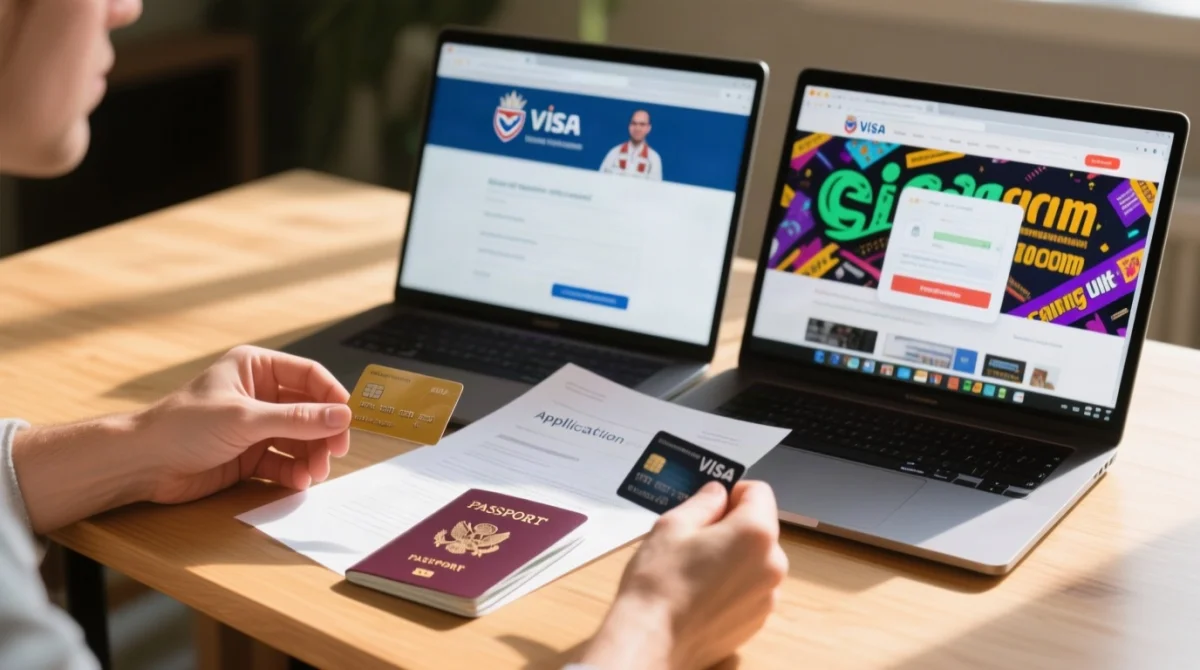
Red Flags of Fake Mozambique eVisa Websites
A Mozambique eVisa scam uses lookalike domains, demands cryptocurrency or wire transfers, promises guaranteed approval, and requests excessive personal data beyond standard application requirements. The legitimate Mozambique eVisa portal at evisa.gov.mz charges approximately 47 US dollars (37 USD visa fee plus 10 USD service fee) and accepts only credit or debit card payments via a secure gateway.
- Non-.gov.mz domains: Scam sites use .com, .org, .info, or .net extensions instead of the genuine .gov.mz TLD.
- Unusual payment methods: Requests for cryptocurrency, wire transfers, or gift cards are direct red flags. The correct portal accepts card payments only.
- Inflated fees: Fraudulent platforms typically charge $100 to $300+, compared with the legitimate ~47 USD cost.
- Generic email addresses: Communications from @gmail.com or @outlook.com indicate fraud; the real portal uses the evisa.gov.mz domain exclusively.
- Guaranteed approval promises: No legitimate platform guarantees visa approval before document review.
- Excessive data requests: Scam sites ask for information beyond standard Mozambique eVisa requirements, such as full bank details or social media passwords.
- Tiered “rush” processing: “Rush” or “Super Rush” options are commercial upsells with no equivalent on the government portal.
- Social media advertisements: A Mozambique eVisa scam frequently reaches UK travellers through sponsored Facebook, Instagram, and Google Ads campaigns.
- Phishing emails: Unsolicited messages mimicking eVisa confirmations often contain links to fraudulent portals.
- Counterfeit visa PDFs: Fake sites issue invalid documents with copied government logos that result in boarding denial or entry refusal.
- Bogus SSL certificates: Some scam sites display invalid or mismatched SSL certificates despite the padlock icon.
How to Verify and Use the Correct Mozambique eVisa Portal
The legitimate Mozambique eVisa portal is evisa.gov.mz, operated by the Servico Nacional de Migracao under the Portal do Governo; any .com, .net, .org, or .info clone is an unauthorised lookalike. The .gov.mz top-level domain is reserved exclusively for Mozambican government institutions, which means a scam operator cannot register it.
| Correct Portal | Common Scam Site |
|---|---|
| evisa.gov.mz (.gov.mz TLD) | – |
| Servico Nacional de Migracao / Portal do Governo | No government affiliation; no verifiable authority |
| Standard card payment via secure gateway (~$47 USD) | Crypto, wire transfer, gift cards; fees $100-$300+ |
| Email communication from evisa.gov.mz domain | Generic @gmail.com / @outlook.com addresses |
Understanding the Difference Between an eTA and an eVisa
An eTA grants pre-travel clearance for up to 30 days to visa-exempt passport holders travelling for Tourist or Business purposes, while an eVisa is a full visa for non-exempt nationalities. Both are processed exclusively through evisa.gov.mz. Scammers exploit the confusion between these two document types by selling travellers the wrong or entirely fictitious authorisation.
Mozambique eVisa Fees, Processing Times, and Protecting Your Data
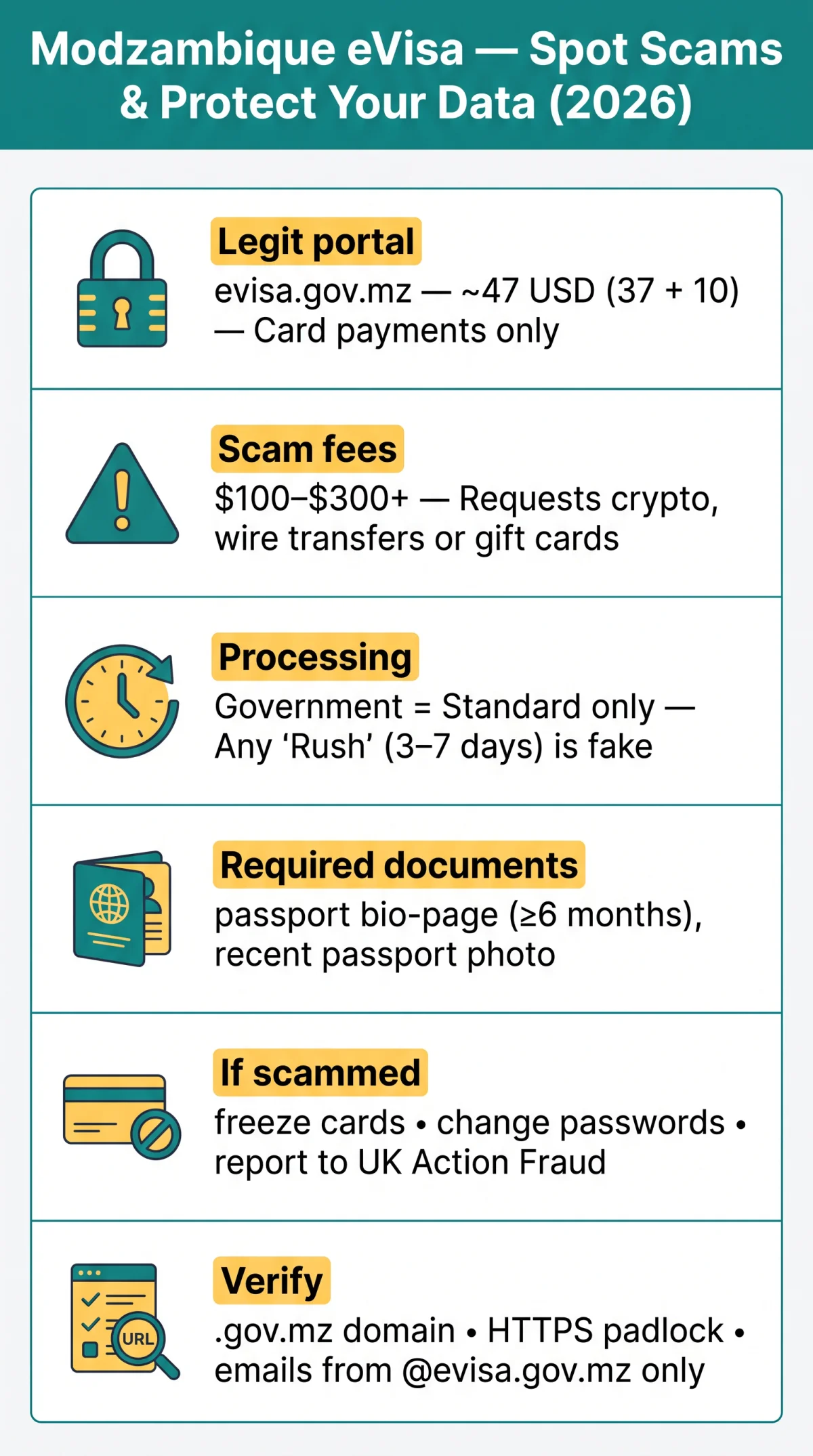
A Mozambique eVisa scam charges applicants between $100 and $300+ for a visa that legitimately costs approximately 47 US dollars (37 USD visa fee + 10 USD service fee) through the government portal at evisa.gov.mz.
| Item | Legitimate Portal (evisa.gov.mz) | Typical Scam Site |
|---|---|---|
| Total fee | ~47 USD (37 + 10) | $100-$300+ |
| Processing tiers | Standard only | “Rush” / “Super Rush” upsells |
| Refund policy | Non-refundable (stated clearly) | Vague or false guarantee promises |
| Payment method | Credit / debit card via secure gateway | Wire transfer, crypto, gift cards |
| Communication | evisa.gov.mz domain only | @gmail.com / @outlook.com addresses |
Legitimate Processing Times vs. Rush Upsells
The Mozambique eVisa scam relies on “Rush” (5-7 working days) and “Super Rush” (3-5 working days) tiers that do not exist on the government portal. Standard processing is the only option offered by the legitimate platform, making any accelerated promise a commercial fabrication.
Safe Payment Methods and Scam Communications
The correct Mozambique eVisa portal accepts credit and debit cards through a standard secure payment gateway. A Mozambique eVisa scam instead demands wire transfers, cryptocurrency, or gift cards, and contacts applicants from generic email domains such as @gmail.com or @outlook.com. Passport numbers, full payment card details, and biometric data are at risk on fraudulent sites. Always confirm the URL shows .gov.mz before entering any information.
How to Protect Your Personal Data When Applying for a Mozambique eVisa
Fake Mozambique eVisa sites harvest passport numbers, full names, dates of birth, email addresses, credit card details, home addresses, and passport scan or biometric images through credential-harvesting scripts such as keyloggers and form grabbers embedded in fraudulent application portals. This data can be used for identity theft, financial fraud, and resale on dark web marketplaces. To protect yourself when applying for a Mozambique eVisa, use strong passwords, enable two-factor authentication, avoid public Wi-Fi, and verify the HTTPS connection and .gov.mz domain before entering any personal data.
Mozambique eVisa Application Process: A Step-by-Step Guide
Apply for your Mozambique eVisa at evisa.gov.mz by following the 3-step process: upload necessary documents, securely pay the fees, and receive the preliminary eVisa notification via email in PDF format.
Upload necessary documents
Select your visa type and enter your nationality. Upload a passport bio-page scan with minimum 6 months validity and a recent passport photo with neutral expression and no filters.
Securely pay the fees
Pay approximately 47 US dollars (37 USD visa fee + 10 USD service fee) via credit or debit card through the secure payment gateway.
Receive preliminary eVisa
The portal delivers a preliminary eVisa as a PDF by email. You must print it and present it at arrival in Mozambique.
Dual nationality holders must use the passport they will travel with. A valid Mozambique eVisa approval arrives in PDF format with genuine layout from the evisa.gov.mz domain.
Key Visa Types and Who Can Apply
Mozambique offers Tourist (vacation, up to 90 days), Business (conferences, up to 90 days), Investment (minimum US$500,000), Sports and Culture, Crew, and Humanitarian Assistance eVisas. Nationals of Pakistan, Bangladesh, Ethiopia, Nigeria, Nepal, and Somalia must apply through their nearest embassy instead of the eVisa portal.
Check if You Need a Visa or Are Exempt
Certain nationalities are visa-exempt, including South Africa (30 days on ordinary passports), Kenya (90 days), Tanzania (90 days), Botswana (90 days), Rwanda (90 days), Namibia (30 days), Malawi (30 days), and Zimbabwe (30 days). Visa-exempt travellers may still require an eTA, submitted at least 48 hours before departure. Mozambique does not offer visa on arrival; all travellers must obtain an eVisa or eTA online through evisa.gov.mz before departure.
What to Do If You Used a Scam Mozambique eVisa Website
Freeze payment cards
Contact your bank to request a chargeback. If you paid via wire transfer or cryptocurrency, recovery is extremely difficult.
Change all passwords
Enable bank fraud alerts on your accounts.
Report the fraud
Report to UK Action Fraud at, and notify Mozambique’s Servico Nacional de Migracao cybercrime channels.
Monitor your credit
Check through Experian, Equifax, or TransUnion UK; consider a credit freeze.
Check FCDO travel advice
Visit gov.uk for current Mozambique scam alerts. Subscribe to email updates for scam warnings.
Reapply
Reapply through evisa.gov.mz using a separate, secure device if malware is suspected.
Legal Consequences of Presenting a Fraudulent eVisa
Presenting a counterfeit Mozambique eVisa at immigration can result in airline boarding denial, entry refusal at the Mozambique border, potential fines, or detention. A Mozambique eVisa scam leaves victims not only financially drained but facing these legal risks. Always verify your document is genuine before travel.
Mozambique eVisa Scam FAQ
What is a Mozambique eVisa scam?
A Mozambique eVisa scam is a fraudulent website impersonating the Mozambique government eVisa portal at evisa.gov.mz. These fake sites overcharge fees to $100-$300+ versus the legitimate 47 US dollar cost, harvest personal data including passport scans and credit card numbers, and may issue worthless invalid documents that result in boarding denial or entry refusal at Mozambique immigration.
How can I tell if a Mozambique eVisa website is legitimate?
The legitimate Mozambique eVisa portal uses the.gov.mz top-level domain at evisa.gov.mz, operated by Servico Nacional de Migracao under the Portal do Governo. It charges approximately 47 US dollars (37 USD visa fee plus 10 USD service fee) with no tiered rush processing, accepts standard credit and debit cards, and does not request cryptocurrency, wire transfers, or gift cards.
What personal data do fake eVisa sites steal?
Fraudulent Mozambique eVisa sites harvest passport numbers, full names, dates of birth, email addresses, credit card details, home addresses, and passport scan or biometric images through credential-harvesting scripts such as keyloggers and form grabbers embedded in fake application portals. This data can be used for identity theft, financial fraud, and resale on dark web marketplaces.
What are the Mozambique eVisa fees in 2026?
The legitimate Mozambique eVisa costs approximately 47 US dollars, comprising a 37 USD visa fee and a 10 USD service fee, payable via credit or debit card through the secure payment gateway on evisa.gov.mz. The fee is non-refundable. Websites charging $100 to $300+ for a Mozambique eVisa are likely fraudulent and should be avoided.
Can I get a refund if I used a scam site?
If you paid by credit or debit card, contact your bank or card issuer immediately to request a chargeback or dispute the transaction. Recovery for payments made via wire transfer or cryptocurrency is extremely difficult. Report the incident to UK Action Fraud at and monitor your credit reports through Experian, Equifax, or TransUnion UK for signs of identity theft.
What should I do if I have been scammed?
Cancel or freeze your payment cards immediately, change all passwords, and enable bank fraud alerts. Report to UK Action Fraud at. Contact your bank to request a chargeback if you paid by card. Monitor credit reports through Experian, Equifax, or TransUnion UK. Reapply for your Mozambique eVisa through evisa.gov.mz using a separate, secure device.
Is it safe to get a Mozambique visa online?
Yes, it is safe to apply for a Mozambique eVisa online provided you use the correct government portal at evisa.gov.mz, which is operated by Servico Nacional de Migracao. Verify the.gov.mz domain, use a secure connection with HTTPS, avoid public Wi-Fi, and never share payment details with sites requesting cryptocurrency, wire transfers, or gift cards.
What is the difference between an eVisa and an eTA for Mozambique?
An eVisa is a full electronic visa for travellers whose nationalities require one, while an eTA is a pre-travel electronic travel authorisation for visa-exempt nationalities allowing stays up to 30 days for tourist or business purposes with all passport types. Both are processed through evisa.gov.mz and scammers exploit the confusion between the two schemes.
Can I get a visa on arrival in Mozambique?
No. Mozambique does not offer visa on arrival. All travellers must obtain an eVisa or eTA online through evisa.gov.mz before departure. Any website or advertisement claiming to provide visa on arrival in Mozambique is using a scam tactic to mislead travellers and should be reported to UK Action Fraud at.
How do I report a fake Mozambique visa website in the UK?
Report fraudulent Mozambique eVisa websites to UK Action Fraud at. Notify your bank or card issuer to dispute the charge and protect your accounts. You may also contact the Mozambican embassy in London for guidance on legitimate visa procedures. Subscribe to GOV.UK FCDO travel advice email updates for current scam warnings and Mozambique travel alerts.
Last updated: 11 September 2026. Fees and processing times are based on the Mozambique eVisa portal as of this date.
Disclaimer: This is an independent informational guide for travellers. It is not affiliated with the Mozambique government or Servico Nacional de Migracao. Always verify details directly on evisa.gov.mz.